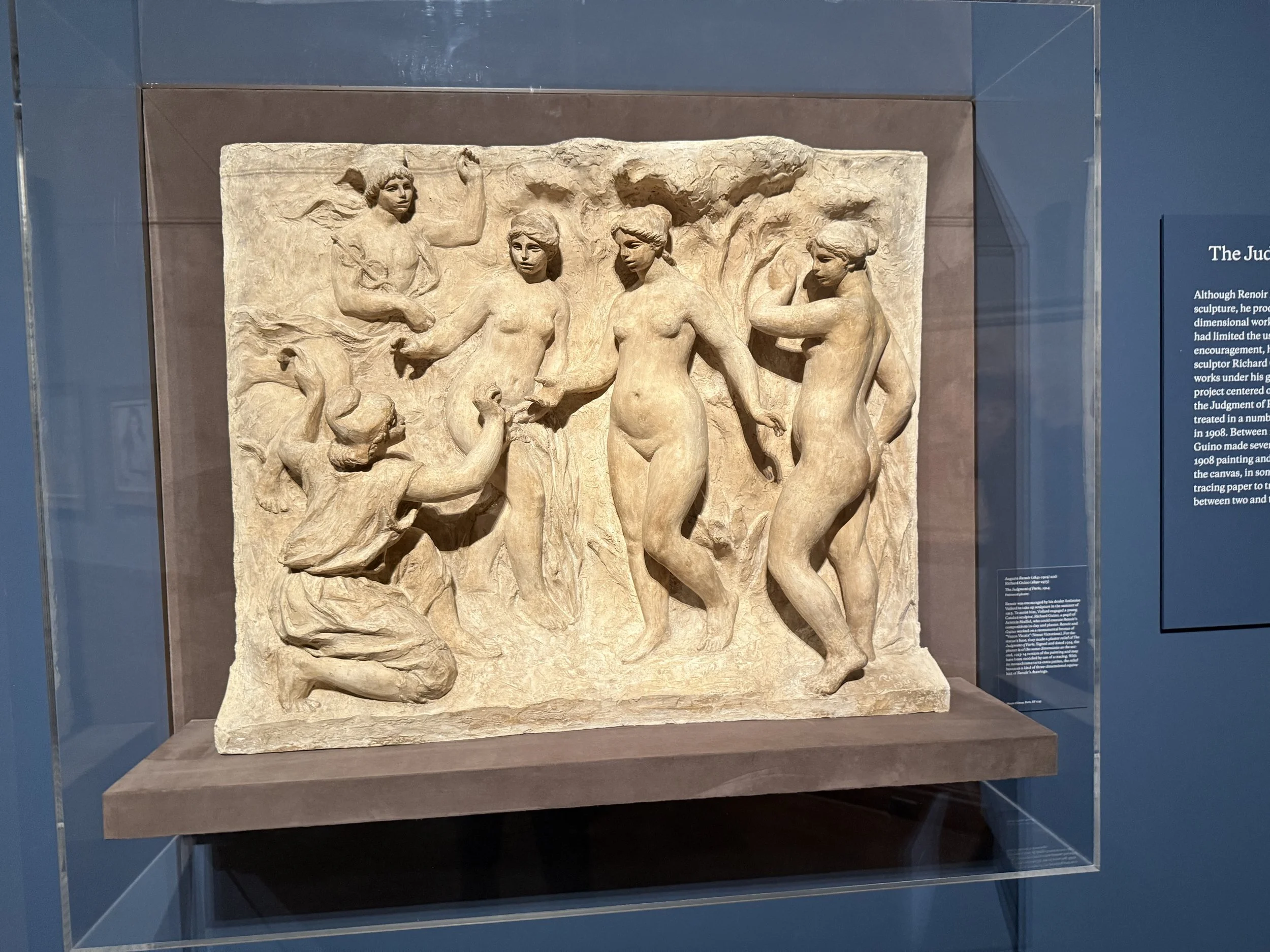
Renoir on Paper: Revealing the Creative Process
The historical American financier John Pierpont Morgan (1837–1913) was a dominant figure in Gilded Age finance who founded the now modern, massive multinational banking institution that became JPMorgan Chase & Co., the largest bank in the United States.
The Morgan Library & Museum, located at 37th Street and Madison Avenue in New York City, was originally the private library of nineteenth-century financier J.P. Morgan. Now reconfigured, it is a museum and research library housing a vast collection of rare books, manuscripts, drawings, and art. Housed in a complex of historic buildings, including the original 1906 McKim-designed library, it now—after recent expansion—features stunning architecture, rotating exhibitions, and a significant collection of items ranging from the ancient world to modern times. Highlights include the Gutenberg Bible and works by Chopin and Rembrandt, as well as a unique set of shops offering novel and high-quality literature and products.
A current exhibition of extraordinary depth is that of Auguste Renoir (1841–1919), a quintessential artist of the Impressionist period.
In spring 1887, Hippolyte Adam, a prominent banker in Boulogne-sur-Mer, a town north of Paris, commissioned Renoir to make a portrait of his daughter Madeleine (1873–1955).
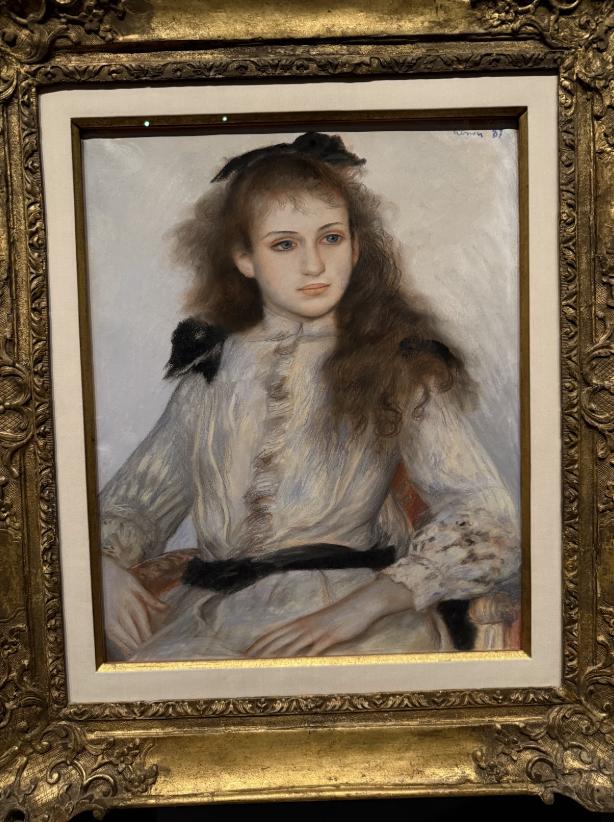
Madeleine Adam, 1887
Adam considered Renoir a “new, little-known artist” despite his established reputation in the Paris avant-garde. Renoir made a preliminary sketch before producing this carefully detailed, finished pastel, a process the sitter herself remembered many years later. This traditional approach, as well as Renoir’s use of pastel—a medium favored by several highly regarded eighteenth-century artists—was probably intended to appeal to the relatively conservative tastes of the client.
Renoir’s drawings, watercolors, and pastels are the subject matter of the present exhibition; these are far less known than his iconic paintings, which were long considered a high point in French late nineteenth- and early twentieth-century art.
This current exhibition will do much to rectify that imbalance. It is an extensive show that also highlights the artist’s creative process, which translates directly into his paintings. The viewer travels through the methods Renoir used on paper to test ideas, explore composition, and interpret both landscape and the human figure.
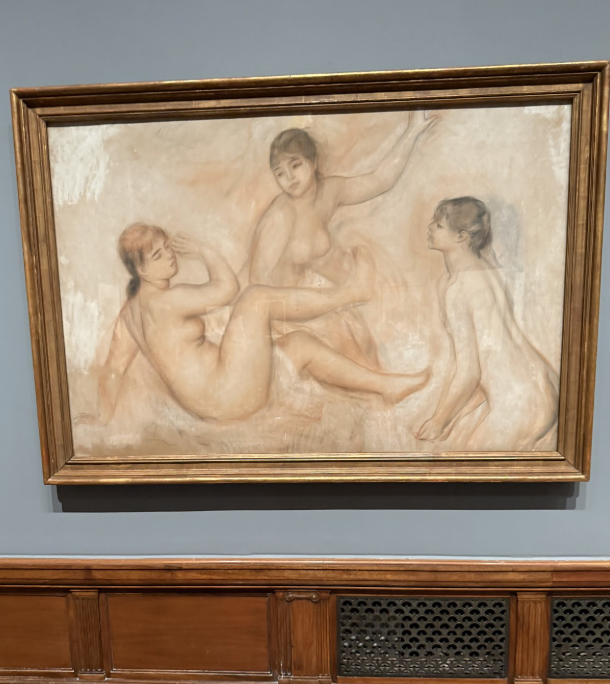
“As he later recalled, by 1883 Renoir felt he had ‘come to the end of Impressionism,’ and he sought to renew his practice with more rigorous drawing and painting techniques. Perhaps his most ambitious and pondered statement of this new approach was The Great Bathers, which he first exhibited in May 1887 with the title Bathers: Experiment in Decorative Painting (Baigneuses. Essai de peinture décorative).
Beginning in about 1885–86, Renoir executed some twenty preparatory drawings for this canvas, through which the development of the composition can be traced. He relied on an iterative process, starting with overall sketches and moving on to detailed studies of individual or paired figures, to test different options before arriving at the complex configuration and sharply delineated forms of the final work. Several of these preparatory drawings are here reunited with the painting for the first time since they were in Renoir’s studio.”
The exhibition is divided into sections that cover the full span of the artist’s career. The works range from academic studies from his student days to spontaneous impressions of both urban and rural scenes made throughout his life. They span formal portraits as well as intimate scenes of friends and family completed later in his career.
The viewer can follow in-depth studies of familiar compositions and preparatory works for the landmark paintings that today are most closely associated with Renoir.
Whether one has prior knowledge of Renoir’s work or simply curiosity about the creative process—depicted here in detail through studies and formal exploration leading to his more familiar paintings—this is an exhibition not to be missed. It runs through 8 February 2026.